
Choosing the Right Aluminum Alloy for Extrusion Applications
Key Takeaways
- Choosing the right aluminum alloy for extrusion applications depends on factors such as strength, corrosion resistance, machinability, and surface finish requirements.
- 6061 aluminum is commonly used when strength and machinability are the top priorities.
- 6063 aluminum is often preferred for complex profiles and applications requiring a smooth surface finish or anodizing.
- Selecting the correct alloy early in the design process can improve manufacturability and reduce downstream machining and production costs.
- Working with an experienced extrusion partner like Profile Precision Extrusions helps engineers evaluate alloy options and optimize designs before production begins.
Introduction
Choosing the right aluminum alloy for extrusion applications isn’t just a material decision. It directly impacts performance, manufacturability, cost, and lead time.
Engineers often need to balance strength, corrosion resistance, machinability, and surface finish, while also considering extrusion complexity and downstream processes.
This guide breaks down how to select the right alloy based on real-world engineering requirements and shows how working with an experienced extrusion partner like Profile Precision Extrusions can simplify the process and reduce risk.
How Do You Choose the Right Aluminum Alloy for Extrusion Applications?
Quick Answer:
To choose the right aluminum alloy for extrusion, evaluate:
- Strength requirements (load, stress, structural use)
- Corrosion exposure (indoor vs outdoor, chemicals, moisture)
- Machinability needs (secondary operations required)
- Surface finish and anodizing requirements
- Profile complexity and wall thickness
- End-use application and industry standards
Most projects come down to a tradeoff between strength (6061) and extrudability/finish (6063).
Selecting the best aluminum alloy for an extrusion project begins with understanding the functional requirements of the final component. Engineers typically evaluate several key factors, including strength, corrosion resistance, machinability, and finishing requirements, before choosing an alloy.
In many cases, the decision involves balancing strength with extrudability. Higher-strength alloys may require more careful processing, while alloys that extrude easily can support complex shapes and improved surface finishes.
Profile Precision Extrusions works closely with engineers during the early design phase to help determine which aluminum alloys best support the intended application. This collaborative approach allows customers to refine designs, select appropriate alloys, and reduce the risk of costly design changes later in production.
Profile Precision Extrusion’s Aluminum Extrusion Design Guide provides detailed engineering guidance on alloy selection, profile geometry, tolerances, and manufacturability best practices.
Key Factors That Influence Aluminum Alloy Selection
Several important factors influence aluminum extrusion alloy selection.
Strength Requirements
Applications that require higher structural performance often use stronger aluminum alloys such as 6061. These alloys perform well in components that must withstand mechanical stress, load-bearing conditions, or demanding operating environments.
Typical examples include aerospace components, industrial machinery parts, and structural assemblies.
Profile Precision Extrusions frequently works with engineers in aerospace, medical, and industrial sectors to develop high-strength miniature extrusions that meet tight tolerance requirements.
Corrosion Resistance
If an extrusion will be exposed to moisture, chemicals, or outdoor environments, corrosion resistance becomes a critical factor. 6061 and 6063 alloys are specifically known for their corrosion resistance while maintaining structural integrity.
Industries such as medical device manufacturing, marine applications, and industrial equipment often prioritize corrosion-resistant alloys.
Profile Precision Extrusions can offer coating options such as chem film coating and anodizing which will minimize the impact of harsh environmental conditions. Discussing coating options early in the design phase can save time in the long run.
Surface Finish and Anodizing
Some applications require a high-quality surface finish or decorative anodizing. In these situations, alloys with excellent finishing characteristics are typically preferred.
6063 aluminum is widely used when a smooth, consistent surface finish is important, especially for anodized parts and precision profiles. 6061 alloy can also be anodized for protection against environmental factors.
Profile Precision Extrusions regularly supplies anodized extrusions for a wide variety of industries, including Medical, Aviation, and Industrial.
- Commercial Type II anodize is an excellent choice where a good cosmetic appearance or corrosion protection is desired. A wide variety of colors, in addition to clear, are available.
- Hard Coat Type III anodize offers increased wear resistance, typically needed for industrial applications. It is available in grey and black.
Machinability
Many extruded components require secondary machining processes such as drilling, milling, or cutting. Alloys that machine easily can help reduce manufacturing time and speed to market.
The chart below is taken from our Design Guide and provides a quick reference point when considering the characteristics of each alloy.
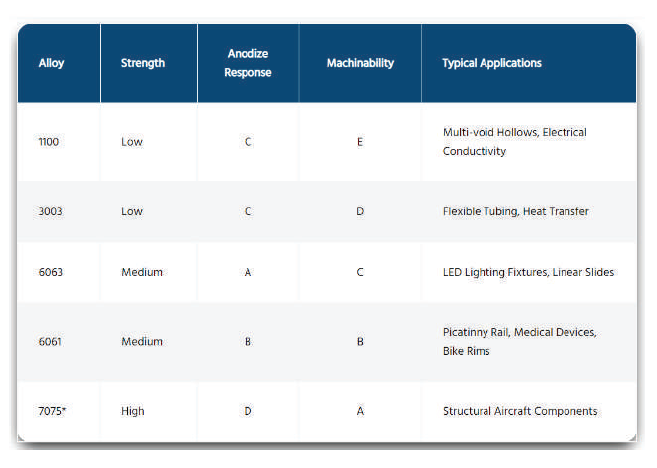
6061 aluminum is commonly selected for projects that involve significant machining because it provides excellent machinability. Profile Precision Extrusions offers in-house machining and fabrication services, allowing customers to receive finished components without the need to coordinate with multiple vendors.
Extrusion Complexity
The complexity of the extrusion profile can also influence alloy selection. Thin walls, intricate shapes, and tight tolerances benefit from alloys that flow more easily during the extrusion process.
Profile Precision Extrusions specializes in complex, miniature aluminum extrusions that many manufacturers consider difficult or impossible to produce. By selecting alloys with strong extrudability, engineers can achieve detailed profiles while maintaining tight tolerances.
Engineering Insight:
In precision and miniature extrusion applications, flexibility in alloy selection becomes even more critical. Small changes in alloy composition can significantly impact extrusion feasibility.
Profile Precision Extrusions specializes in helping engineers navigate these constraints during the design phase, particularly for complex or tight-tolerance profiles.
Need help selecting the right alloy?
Profile Precision Extrusions works directly with engineers to evaluate designs, recommend materials, and optimize extrusion feasibility before production begins.
Request a consultation to review your design
Common Aluminum Alloys Used for Extrusion Applications
While many aluminum alloys are available, a few are used more frequently in extrusion applications due to their versatility and performance.
6061 Aluminum
6061 aluminum is one of the most widely used alloys for extrusion projects.
It offers:
- Medium strength
- Good machinability
- Good corrosion resistance
This alloy is often used in aerospace interior components, industrial machinery, and structural parts where durability is important.
6063 Aluminum
6063 aluminum is commonly selected for projects that require excellent surface quality and complex shapes.
Benefits include:
- Smooth surface finish
- Excellent anodizing results
- Strong extrudability
This alloy is often used for thin-wall profiles, multi-hollow designs, and applications where appearance is more important.
6061 vs 6063 Aluminum Extrusion
Engineers frequently compare 6061 vs 6063 aluminum extrusion when determining the best aluminum alloy for extrusion applications.
In simple terms:
- 6061 aluminum is typically chosen when strength and machining performance are the top priorities.
- 6063 aluminum is often preferred when a smooth surface finish, anodizing quality, or complex extrusion geometry is required.
Profile Precision Extrusions works with customers to evaluate both options and determine which alloy best supports the specific requirements of the project.
How Alloy Selection Impacts Manufacturing Efficiency
The aluminum alloy chosen for an extrusion project affects more than just product performance. It can also influence manufacturing efficiency and overall production costs.
Factors such as extrusion difficulty, machining requirements, finishing processes, and material waste can all impact the total cost of production.
By working with Profile Precision Extrusions during the design phase, engineers can identify alloys that simplify manufacturing while maintaining the required performance characteristics.
Selecting the Right Aluminum Alloy for Your Project
Choosing the right aluminum alloy for extrusion applications is critical to achieving the right balance of performance, manufacturability, and cost.
The earlier this decision is made, the easier it is to avoid design revisions, reduce machining requirements, and streamline production.
Profile Precision Extrusions partners with engineers early in the process to evaluate alloy options, optimize designs, and ensure successful production outcomes, especially for complex or tight-tolerance extrusions.
Request a quote or engineering consultation to determine the best aluminum alloy for your application.
Frequently Asked Questions
What aluminum alloy is best for extrusion?
The best aluminum alloy for extrusion depends on your application requirements.
-
- Use 6061 aluminum when strength, durability, and machining are priorities
- Use 6063 aluminum when surface finish, anodizing, or complex profiles are critical
In many cases, engineers evaluate both options with an extrusion partner to determine the best balance of performance and manufacturability.
What is the difference between 6061 and 6063 aluminum extrusion?
How does aluminum alloy selection affect manufacturing cost?