
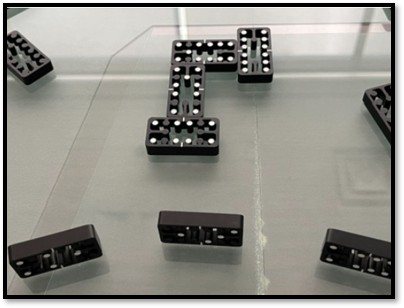
DESIGN PRINCIPLES FOR SUCCESSFUL EXTRUSION
For a more manufacturable custom aluminum extrusion:
- Identify the 1 to 2 dimensions that are truly critical to fit or function.
- Keep wall thickness as uniform as the application allows.
- Use rounded corners and fillets instead of unnecessary sharp internal corners.
- Favor symmetry when it does not compromise part performance.
- Reduce deep, narrow openings that create difficult tongue ratios.
- Specify cosmetic surfaces so handling and finishing requirements are clear.
- Select alloy and temper based on the mechanical, finishing, and manufacturing requirements of the part.
- Share CAD files, tolerances, estimated quantity, fabrication needs, and finishing requirements if known.
We don’t have a minimum order size.
PPE can review these inputs before you commit to production tooling. Early design review is especially useful for miniature profiles, thin walls, tight tolerances, and geometry that other extruders have declined.
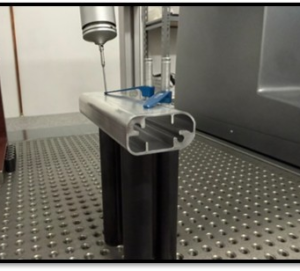
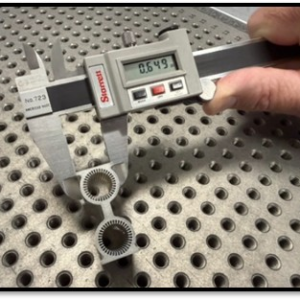
WHAT INFORMATION SHOULD ENGINEERS INCLUDE IN AN EXTRUSION DESIGN?
A useful extrusion drawing communicates which requirements drive function and which dimensions have room for normal process variation. PPE recommends identifying as many the following as possible before requesting a quote:
- Sketch, 2D or 3D File
- Critical dimensions and required tolerances
- Alloy and temper
- Estimated order quantity or annual volume
- Desired cut length
- Fabrication or machining requirements
- Finishing requirements, including anodizing, chem film, or powder coating when applicable
- Cosmetic or appearance-critical surfaces
- Fit, mating, or assembly requirements that affect the profile
Do not apply the tightest possible tolerance to every dimension by default. Calling out the dimensions that actually control fit, function, or downstream machining helps PPE evaluate the profile around the requirements that matter most.
HOW SMALL CAN PPE EXTRUDE AN ALUMINUM PROFILE?
PPE is focused on miniature and precision aluminum extrusions. The smallest tube we have ever extruded is .094” OD x .019” wall thickness. The aluminum alloy was 3003.

Profile Size
PPE’s current design guidance calls for profiles that fit within approximately a 3.5 to 4.0 inch diameter circle. The published Shapes page further identifies capabilities up to a 4-inch circle size for solid shapes and up to a 2.5-inch circle size for round tubing.
If your profile is near the edge of these limits, send the cross-section to PPE for review. Geometry can affect feasibility even when the overall envelope appears to fit.

Minimum Wall Thickness by Alloy
Current PPE design guidance lists these minimum wall thicknesses:
Alloy | Published Minimum Wall Thickness
3003 | 0.020 in.
6063 | 0.025 in.
6061 | 0.030 in.
These values are design guidelines, not a guarantee that every profile can be produced at the listed minimum. Wall thickness feasibility depends on the complete cross-section, alloy, profile size, and tolerance requirements.
HOW SHOULD CRITICAL DIMENSIONS AND
TOLERANCES BE SPECIFIED?
Identify the 1 to 2 dimensions that have the greatest impact on fit, function, or assembly, then specify the tolerance those dimensions actually require.
PPE’s precision extrusion capabilities regularly produce dimensions half of standard commercial aluminum tolerances. Achievable tolerance still depends on the profile, alloy, dimension location, and wall thickness.
For an engineering review, clearly distinguish:
- Critical-to-function dimensions
- Reference dimensions
- Mating or telescoping dimensions
- Features that will be machined after extrusion
- Straightness, bow, or twist requirements
- Cosmetic requirements
This gives PPE’s team a better basis for recommending where extrusion can hold the requirement directly and where a secondary machining operation may be the better manufacturing strategy.
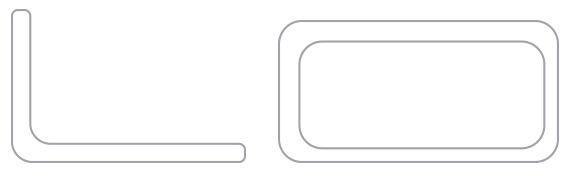
WHY DOES UNIFORM WALL THICKNESS MATTER IN ALUMINUM EXTRUSION DESIGN?
Uniform wall thickness generally improves metal flow through the die and makes an aluminum extrusion easier and more economical to produce consistently.
Large variations in wall thickness can cause different areas of the extrusion to flow at different rates. When the design allows it, keeping walls balanced reduces unnecessary manufacturing difficulty. If the application needs localized strength, a rib, boss, or targeted thicker section may be more effective than increasing material across the entire profile.
PPE can evaluate your design and suggest changes that preserve the engineering intent while improving manufacturability.
WHY ARE ROUNDED CORNERS AND FILLETS PREFERRED?
Rounded corners and fillets are easier to extrude than sharp corners because aluminum must flow through and around the die geometry.
Avoid specifying a sharp internal corner unless the application truly requires it. A practical radius can improve die strength and metal flow while reducing unnecessary manufacturing difficulty.
If a mating feature requires a specific corner condition, identify that functional requirement on the drawing so PPE can evaluate the best way to achieve it.

HOW DOES TONGUE RATIO AFFECT EXTRUSION FEASIBILITY?
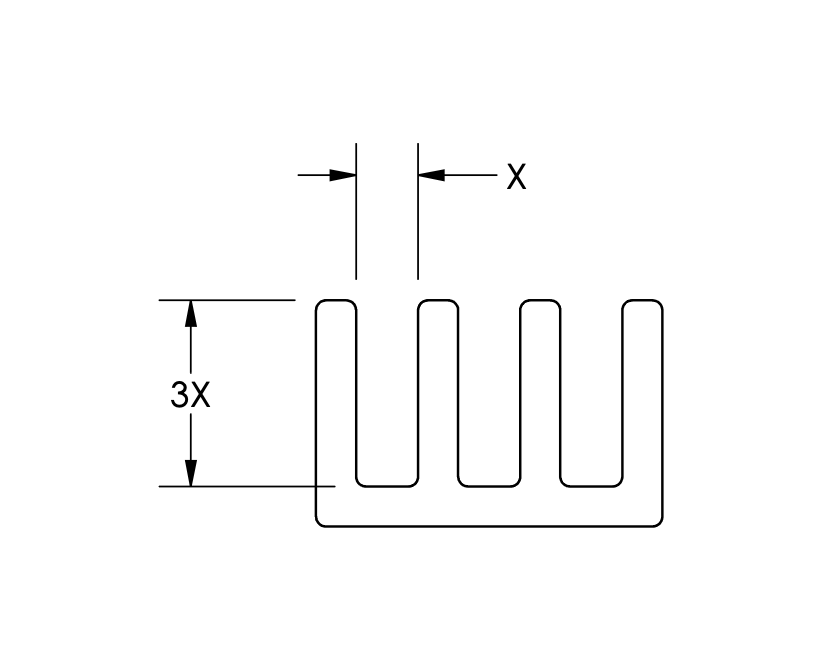
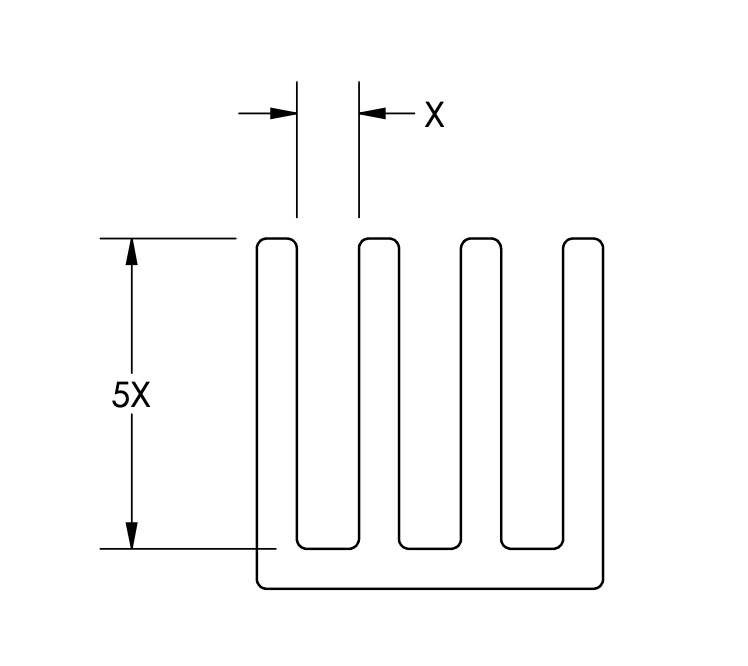
Tongue ratio is a key design consideration for semi-hollow geometry because deep, narrow openings require slender sections of die steel to form the profile. As the opening becomes deeper relative to its width, the die becomes more difficult to manufacture and support under extrusion pressure.
PPE’s existing design guide illustrates the progression this way:
3:1 tongue ratio: easier
5:1 tongue ratio: challenging
8:1 tongue ratio: extremely difficult
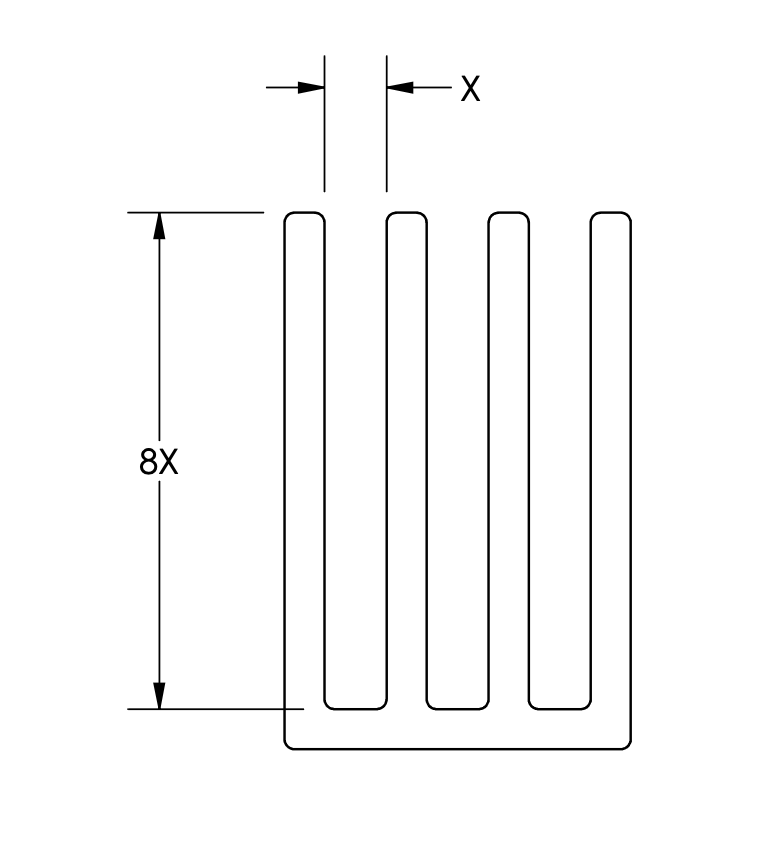
Treat these ratios as a design-screening tool, not a universal pass/fail rule. The full profile geometry, alloy, wall thickness, and die design still determine manufacturability.
If your design contains a deep slot, narrow channel, or semi-hollow feature, send the cross-section to PPE before finalizing the geometry.
SHOULD AN ALUMINUM EXTRUSION BE SOLID, SEMI-HOLLOW, OR HOLLOW?
All three are possible. The right extrusion type depends on the function of the cross-section and how the internal geometry affects die design.
Solid Extrusions
A solid extrusion has no fully enclosed void. Solid profiles are often the most straightforward starting point when the application does not require an internal cavity.
Semi-Hollow Extrusions
A semi-hollow profile contains a partially enclosed void. These designs require close attention to tongue ratio because deep, narrow openings can make the die more difficult to support.
Hollow Extrusions
A hollow extrusion contains one or more fully enclosed voids. Hollow profiles can reduce weight or create functional internal passages, but the die and metal-flow requirements are more complex.
PPE routinely works with engineers on custom profile geometry. Do not redesign a functional hollow or semi-hollow feature solely to make it look simpler on paper. Send the design for review and let manufacturability determine whether a change is actually needed.

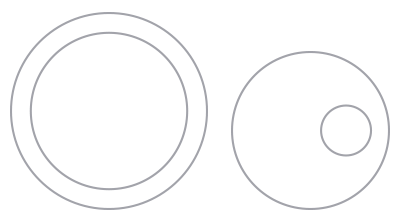
DOES SYMMETRY MAKE AN EXTRUSION EASIER TO MANUFACTURE?
Yes. When the application allows it, symmetrical geometry generally promotes more balanced metal flow and can make an extrusion easier to produce consistently.
An asymmetric profile may still be completely manufacturable. The goal is not symmetry for its own sake. The goal is to avoid unnecessary imbalance when two geometries can accomplish the same engineering function.
For highly asymmetric miniature profiles, PPE can review wall distribution, thin sections, and critical features before tooling.
HOW SHOULD ALLOY CHOICE AFFECT THE EXTRUSION DESIGN?
Alloy selection affects strength, finish, wall capability, heat treatment, and extrusion behavior. PPE regularly produces 6061, 6063, 3003, and 1100 aluminum alloys.
PPE has very limited extrusion and processing capability for aerospace alloys such as 2014, 2024, and 7075 because they require specialized processing and heat treatment. For very small solid shapes, 2024 and 7075 may be available depending on the design.
If we can’t produce it, we are happy to refer you to someone who can.
HOW CAN ENGINEERS DESIGN FOR SECONDARY MACHINING AND FINISHING?
Design the extrusion with downstream operations in mind from the beginning. Features that will be cut, drilled, milled, countersunk, deburred, anodized, chem filmed, or powder coated can influence design strategy.
PPE’s fabrication and machining services including CNC machining, drilling, milling, countersinking, precision cutting, deburring, and finishing. Available finishing options include Type II anodizing, Type III hard coat anodizing, chem film, and powder coating.
If a dimension will be created by machining, identify it accordingly rather than forcing the as-extruded profile to hold a tolerance that the secondary operation will control more reliably.
WHAT MAKES A CUSTOM ALUMINUM EXTRUSION EASIER TO PROTOTYPE?
A prototype is most valuable when it tests the same geometry and critical requirements that matter in production. PPE’s prototype process starts with design review and feasibility feedback before sample production.
Consider prototyping when:
- The profile uses thin walls or complex geometry.
- Critical dimensions have tight tolerances.
- Fit with another component needs to be verified.
- The design replaces a machined or multi-piece assembly.
- The profile has been redesigned for weight, cost, or performance.
- You want to validate the design before committing to production volume.
PPE can produce prototype samples under production-representative conditions to help you validate the profile before production.
ALUMINUM EXTRUSION DESIGN REVIEW CHECKLIST
Before sending your profile for review, answer as many of the following as possible:
- What does the part need to do?
- Which 1 to 2 dimensions are most critical?
- What tolerances are required for those dimensions?
- What alloy and temper are preferred?
- What is the maximum cross-sectional size?
- Are the walls as uniform as the design allows?
- Can sharp internal corners be replaced with rounded radii?
- Does the profile contain deep, narrow channels or difficult semi-hollow features?
- Which surfaces are cosmetic?
- What machining, cutting, deburring, or finishing is required?
- What quantity do you need for prototype and production?
- Are there mating parts or assembly constraints PPE should understand?
You do not need to solve every extrusion-manufacturing detail before contacting PPE. Send the design intent and the requirements you know, and PPE can help identify manufacturability risks before tooling.
FAQ
FREQUENTLY ASKED QUESTIONS ABOUT ALUMINUM EXTRUSION DESIGN
Send a sketch, a 2D drawing or, when available, a 3D CAD file. Include critical tolerances, alloy and temper, estimated quantity, fabrication needs, finishing requirements, and any fit or cosmetic requirements that affect the design.
PPE’s current design guidance lists minimum wall thicknesses of 0.020 inch for 3003, 0.025 inch for 6063, and 0.030 inch for 6061. Actual feasibility depends on the full profile geometry, size, alloy, and tolerance requirements, so minimum wall thickness should be confirmed through design review.
PPE can achieve up to half of standard commercial aluminum tolerances for appropriate profiles. The achievable tolerance depends on the geometry, alloy, dimension, wall thickness, and processing requirements, which is why engineers should identify the truly critical dimensions.
Yes. PPE offers design and manufacturability review before production and can recommend prototyping when the profile would benefit from fit, function, tolerance, or performance validation.
Yes! PPE specializes in small, complex, thin-wall, and tight-tolerance aluminum extrusions, including profiles other manufacturers may decline. Feasibility is design-specific, so the best next step is to send the cross-section and critical requirements for review.
SEND YOUR ALUMINUM EXTRUSION DESIGN TO PPE
Have a drawing, CAD model, or early-stage extrusion concept? Send PPE your design files along with the critical dimensions, alloy preference, quantity, and any machining or finishing requirements.
PPE will review the profile for manufacturability and help you determine the best next step, whether that is a quote, a design refinement, a prototype run, or production.